

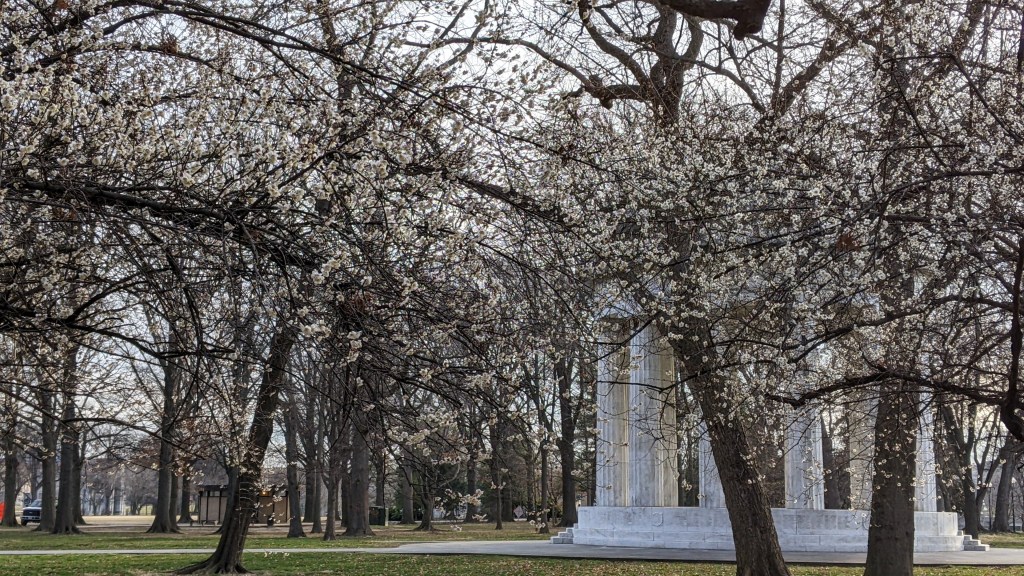
Recently on one of my morning walks, I snapped this photo of early cherry blossoms near the WWI Memorial just off the Washington Mall. On the base on this marble memorial, that changes hue as the sun rises and sets, are the names of D.C. residents that lost their lives in the Great War. Often when I’m walking near by in the early morning, photography equipment graces the steps as soon-to-be brides and grooms or recent graduates in their flowing robes gaze dreamily into the distance –maybe thinking of the past, maybe thinking of the future — but I’m guessing not thinking of the names or memories upon which they stand. In this photo, I particularly enjoy how the memorial is graced with these new blossoms, but also partially hidden – but solid, and foundational as well to the blossoms’ new found existence and beauty.
So too, are writers in publishing. Writers are everywhere — they are the foundation upon which publishing rests and they are everyone that works within, near, adjacent to, and down the road from publishing. In my view, we often think of the real writers as the stars whose names grace book covers or magazine tables of contents; but writers are involved at every step of the way from the website copy of any journal to tweets to contract drafting. These behind-the-scenes writers that often don’t have bylines or signatures are no less creative that those whose books and articles we readers soak up with glee upon publication; these writers make writing happen — they are the foundation, the marble, often hidden, but right there in lockstep with the cherry blossoms. These writers often have not-so-apparent creative writing lives as well, that they work on in the after-hours, crafting away when our own ideas have gone to press (or web, or the myriad of other forms writing gets out into the world).
In my own publishing internship, writers are all around me as every staff person writes in a variety of capacities nearly each day whether for the organization’s blog, editing work of guest writers, composing reports or marketing materials or grant drafts– words are all around everyone, everyday. For me, I’ve had the chance to complete two byline pieces so far (publication pending in April) and will be beginning my next piece within the next several weeks. Writing is the foundation here, whether in front of the camera so to speak appearing in the magazine, or in all that makes the magazine happen (and there is much).
I’ve spent the last few days with friends, one of whom is a writer for a national architecture firm — he’s written books, more articles than I could count if I tried, served as an editor for an architecture magazine, and he’s done a little freelance work for the local PBS station as well. What ties his work all together is the idea that writing is everywhere — there is always a story to tell, though every story is not glamorous perhaps, it is worthy of telling because there are readers out there that need and want to know things about his firm’s projects, or architects or their clients. These reaffirm my own ideas that have taken shape this semester, combined with my own past experiences: writers are all around, within every corner of publishing, and there are a vast number of ways to be a writer.
 3 Coffees A Day