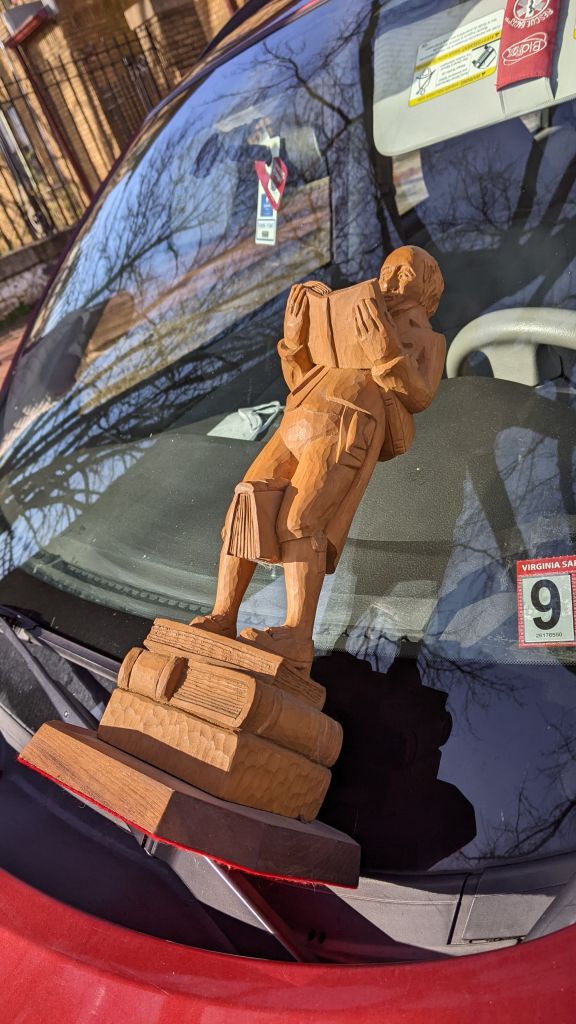
Ben Franklin on my Windshield

Yes, that’s a mini wooden statute of Ben Franklin reading a book, left mysteriously on my car’s windshield recently while my daughter and I were taking a stroll through Congressional Cemetery. Cemetery walking in DC is a THING, it’s normal and at Congressional it’s the best dog meetup in town, as the cemetery offers a membership for dog walkers. To us, it’s dog therapy, as the many fluff balls there on doggy recess will often approach, looking for a little extra love. We come here to gaze at the cherry trees that grace the well-worn rows of graves as well, far away from the hordes that descend on the tidal basin; and of course, for the history — if you really want to know this town, Congressional is one of the must- see, do learn places.

On this day though as we jumped back into “Red” as our Subaru is called, for her cherry-ish coloring, as I was about to put the key in the ignition, I naturally glanced out the front window and well, with me and my language, “What the hell” came out. We both hopped out of the car, and for nearly a minute just gazed at this little statue, resting so peacefully on the glass on this early spring day. Now, Congressional is not located on the best part of Capital Hill — it is a greatly improved area, but its patrons and permanent residents rest in the shadow of the D.C. jail — home to the notorious and temporary law breakers in the city. The neighborhood, glammed up rowhouses aside, does draw the notorious and temporary’s associates to the area, who do have “leave-behinds” that unflatteringly grace the sidewalks on occasion.

My first reaction to the statue: Do we still have any medical gloves in the car from early Pandemic gas getting? No, but we do have an old pair of winter gloves. But where to put Ben? Leave him on the cemetery stoop? Who would leave such a thing? Is it because of all the bookstore stickers on the car? Who is just walking down the road with a Ben to leave on someone’s car? Ben did find a resting place, thanks to a Congressional staffer (cemetery, not Hill) headed inside that offered to place him in the sun, near the office’s entry, but not before she too, asked: Why, who, huh?

This may seem like a long wind-up to sum-up this semester’s adventures in the world of publishing, but while reflection starts with a look-back, it most often leads to more questions. I have no idea who, what, why Ben was left on my car — but it sure is a great story. After a wonderful semester of interning (which still feels really odd at my age, can we think of a new term for this?) with an amazing organization, I can say here in late April, what I have is questions. I’ve written my writer’s contract with many specifics (and notes to add off-ramps and rewards from K.W. – thank you), and several clear directions. But I’ll admit, last night when reading of bell hooks’ work and the volume of volumes she created, I had that oh-so-familiar feeling that I’m spinning my wheels. It was also a long day of grading essays, which often leads to a certain amount of despair, but today I plan to greet the day anew…no more comparing my lack of volumes to anyone. The journey is just the journey, and some days aren’t going to be great when it comes to production, focus, or walking on the treadmill of life (hence off-ramps and rewards, thanks x two, K.W.).

My internship will continue into the summer (yeah), and I will be able to work again with my organization’s team as well as one of my treasured MFA mentors, write in the realm of spirituality, and perhaps board yet another train north to Philadelphia. Ben Franklin. Philadelphia. Ben Franklin. One book on my to-read list is Signs: The Secret Language of the Universe. As a person who thinks every blue bird is my grandmother visiting with a message, I am pretty convinced Ben’s appearance on my window is no coincidence. Philadelphia. Ben Franklin. Philadelphia. Ben Franklin. Books, books, books. Write, write, write — hello thesis year! Shall I dedicate it to Ben? One more question to ask, and answer.
Where are the writers in publishing? Look to the foundations.

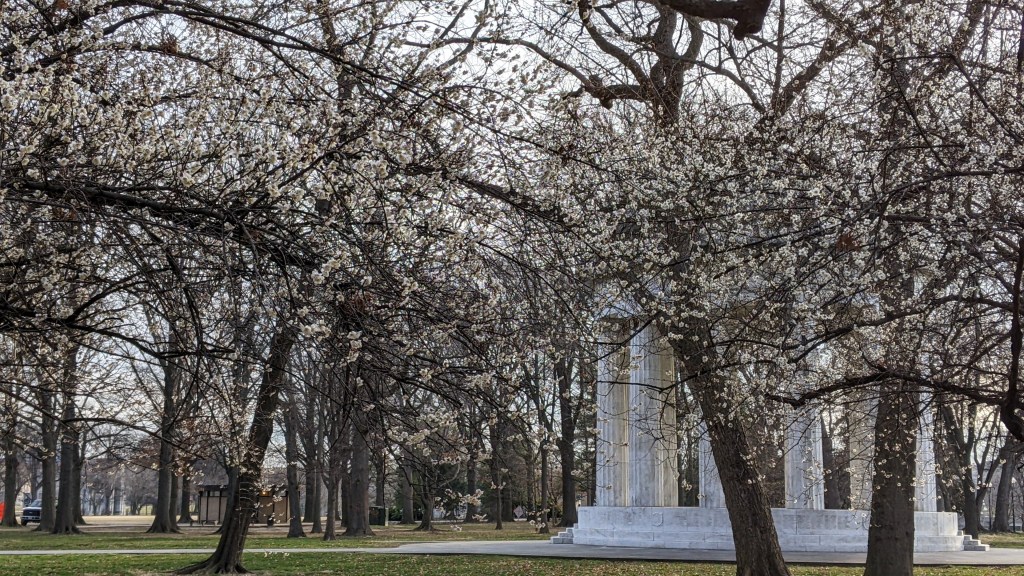
Recently on one of my morning walks, I snapped this photo of early cherry blossoms near the WWI Memorial just off the Washington Mall. On the base on this marble memorial, that changes hue as the sun rises and sets, are the names of D.C. residents that lost their lives in the Great War. Often when I’m walking near by in the early morning, photography equipment graces the steps as soon-to-be brides and grooms or recent graduates in their flowing robes gaze dreamily into the distance –maybe thinking of the past, maybe thinking of the future — but I’m guessing not thinking of the names or memories upon which they stand. In this photo, I particularly enjoy how the memorial is graced with these new blossoms, but also partially hidden – but solid, and foundational as well to the blossoms’ new found existence and beauty.

So too, are writers in publishing. Writers are everywhere — they are the foundation upon which publishing rests and they are everyone that works within, near, adjacent to, and down the road from publishing. In my view, we often think of the real writers as the stars whose names grace book covers or magazine tables of contents; but writers are involved at every step of the way from the website copy of any journal to tweets to contract drafting. These behind-the-scenes writers that often don’t have bylines or signatures are no less creative that those whose books and articles we readers soak up with glee upon publication; these writers make writing happen — they are the foundation, the marble, often hidden, but right there in lockstep with the cherry blossoms. These writers often have not-so-apparent creative writing lives as well, that they work on in the after-hours, crafting away when our own ideas have gone to press (or web, or the myriad of other forms writing gets out into the world).

In my own publishing internship, writers are all around me as every staff person writes in a variety of capacities nearly each day whether for the organization’s blog, editing work of guest writers, composing reports or marketing materials or grant drafts– words are all around everyone, everyday. For me, I’ve had the chance to complete two byline pieces so far (publication pending in April) and will be beginning my next piece within the next several weeks. Writing is the foundation here, whether in front of the camera so to speak appearing in the magazine, or in all that makes the magazine happen (and there is much).

I’ve spent the last few days with friends, one of whom is a writer for a national architecture firm — he’s written books, more articles than I could count if I tried, served as an editor for an architecture magazine, and he’s done a little freelance work for the local PBS station as well. What ties his work all together is the idea that writing is everywhere — there is always a story to tell, though every story is not glamorous perhaps, it is worthy of telling because there are readers out there that need and want to know things about his firm’s projects, or architects or their clients. These reaffirm my own ideas that have taken shape this semester, combined with my own past experiences: writers are all around, within every corner of publishing, and there are a vast number of ways to be a writer.

Reflection: What’s New is Old, but Different

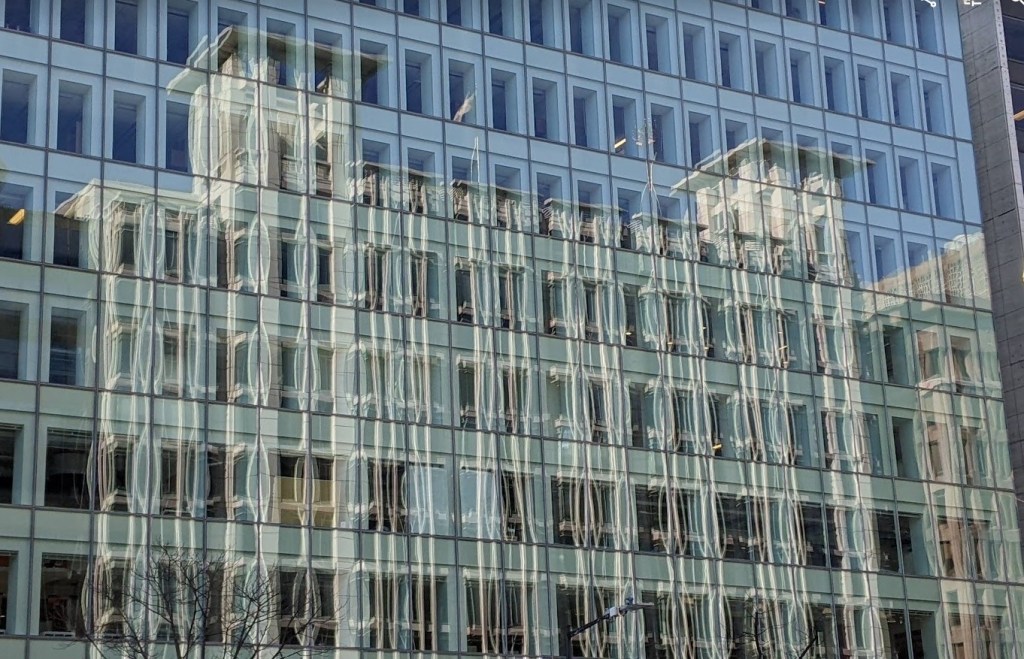
As I sat downtown DC over the weekend at my favorite corner (17th and Pennsylvania), I noticed this beautiful reflection as I drank Sunday morning coffee with my daughter. The new facade of the building directly in front of me awash in the blue of a mid-February blue sky; it’s expanse of glass reflecting the classical parapet-like structure of the white masonry building on my side of the street. The reflected image fit succinctly into the expanse of new glass; line to line, floor to floor, with the masonry taking on a ghostly note — floating against the moorings of glass just steps away.

So too are discoveries, or perhaps realizations this week. My internship places me back in the world of nonprofits — all the inner workings and intertwining of ideas, plans and strategies to bring the cloudy to solid life — not unlike this streetwise transition from masonry shadow to gleaming glass. When I left this (nonprofit) or first world as I think of it in relation to my career, I didn’t think I would ever feel the pull to return — but here I am, considering the road ahead and feeling pretty certain (though not yet saying aloud) that this is the direction I should head. I’m not sure if I am surprised by this realization, but I welcome it and in some ways I had a distinct hand, and interest in heading toward change. Even now, I hesitate to say I want to leave teaching though it’s been on my writer’s board since last semester to work toward a teaching adjacent day job. I think perhaps this idea of what’s old is new again is fostered by the soft landing — being able to intern within subject matter that I already have an affinity for — and by the graciousness of my interning hosts to welcome me into the fold.

Where this line of thinking will lead, I am not yet sure — but without the current leap I wouldn’t have come to this realization at all, so some organic gardening in respect to letting this realization rest in both camps for awhile, history and future, reflection and expanse is probably the best idea. A boss (Richard) long ago told me it’s always best to know what one doesn’t want, because that makes figuring our what one does want, so much easier. So, I’ll toast Richard from afar as he’s now decamped to Palm Springs — as I know what I don’t want, and I’ll figure out the steps to get what I do want, now that the vision grows clearer.

Rolling on the Rails, Philadelphia-Bound

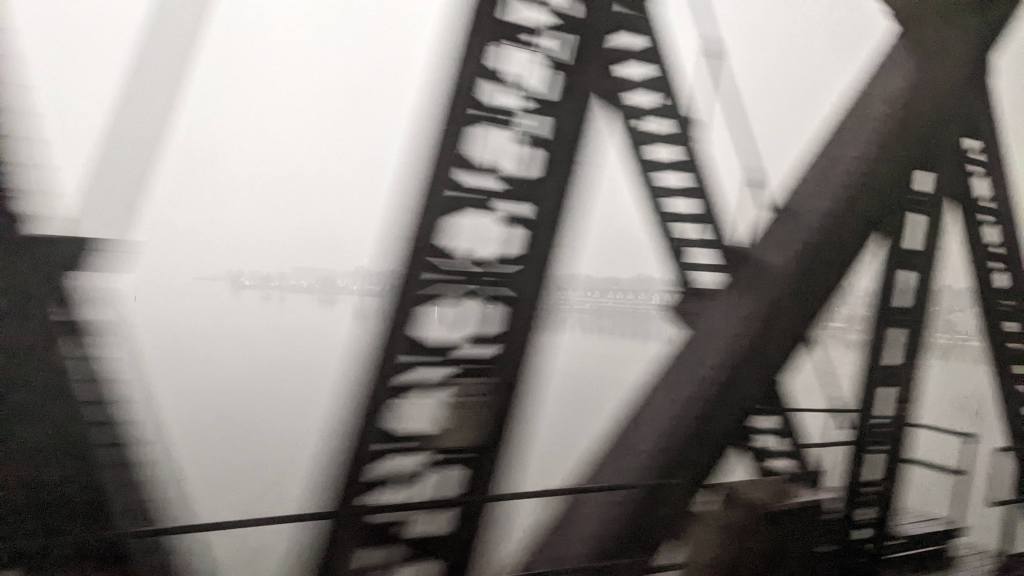
Crossing the Susquehanna River

Anyone who knows me, knows I love trains. This week I’m working on an essay that is about this particular train trip, but has nothing to do with the reason I headed to Philadelphia in late January — on the heels of a snow and ice storm, in intensely dense fog mixed with dripping drizzle. For part of this particular journey I felt like I was back in Seattle, so enveloped in grayness, that it’s tough to find landmarks outside the grit covered windows of my business class seat.

On to the purpose of my trip. I wanted to meet with my internship organization in-person (hq’d in Philadelphia) for a few reasons, most importantly because over the course of my working life, this organization has been part of it in some fashion since late 1998 — and 25 years means something in the broader scope of how we change and morph our careers over time, but can still find ways to work with organizations and people with whom we’ve connected over vast swaths of time and geography.

For this week’s MFA work, I am tasked with writing about my favorite thing with my internship placement — and hands-down, it is the opportunity to work with people and an organization that I admire, and to foster and continue to build relationships. This reflects also what this organization works on each and every day, as well as these over-time relationships: how do we take what we know, consider new ways to use that knowledge (and in this case historic spaces) and imagine what the future may look like where communities are embraced and welcomed. To me, this speaks to a much larger need across the realm of publishing, as well as writing; it feels that too often, closed doors are more often the case and gatekeepers abound while “new” is set aside, because, “that’s just now how it’s done.” I’m not a particular fan of disruption for disruption’s sake, but it does have its place. As an older, professional woman, these issues are of great concern to me as I continue in the workforce and examine new potential roles inside and outside of publishing, writing and education.

In addition to relationships, the nature of how my internship is evolving is also a favorite aspect — as it not only goes to my skills and interests — but also leads me to my roots of professional life as well, where I can (in those rare moments of quiet) envision roles for myself that combine the best of the old life with the best of a new life. Crossroads would be an apt comparison. So far, I’ve been tasked with writing a 1,500 word profile of a dynamic arts organization and next I’ll be working on case studies; both of these involve interviewing a number of people, figuring out a narrative approach, and weaving the story together. For the profile, it will appear in the spring issue of the organization’s magazine; the case studies will appear on the organization’s blog. Next, I’ll be working on interviewing conference attendees that will lead to a published report/proceedings. I’ll only be tangentially involved in production, but I’ve held that role before, so when we recently went over the production schedule for the spring magazine issue — all kinds of details I hadn’t thought about in a long time came back pretty quickly. All of these actions and activities are in-line with the world of organizational, and scholarly/educational publishing which is a lane in which I feel comfortable and one in which I know I can and will explore more possibilities.

January: The Month of Beginnings #baypathmfa #morningview

The sun rose this morning over the top of my chosen treadmill at the gym — shining its winter light and miniscule heat over the frozenness of nearly week old snow and ice that may not melt by spring. In between my view over the treadmill’s control panel, planes landed from the north — following the path of the Potomac River en route to nearby National Airport (as a long timer here, I have never brought myself to call the airport by its new-ish name). The morning begins, the treadmill begins, the planes begin their rapid descent — beginnings are abundant in January. My birthday falls on the first day of January: ground zero for a new year’s beginning throes…there is no escaping the idea that change is upon me each and every year as the ball drops in Times Square — I begin each year with a new number to celebrate, revile or make peace with — there is no predicting how each number will strike me until it us upon me. This year, January is off to a fiery start – new roles and responsibilities, a pending graduation, most likely relocation; the level of planning required to surf through the next five months is filled with if-then statements.

As this month roars along, I find myself in the position of intern as part of my MFA program — a totally new role for me as I’ve never been an intern at any point in my career. And admittedly, it’s not a title I’m completely comfortable with at this point in my life, perhaps I’ll become more accustomed to it as the current semester proceeds. I am incredibly fortunate to be spending my intern time with an organization, and people, that I have great respect for — and I’m thankful for the long-term relationships that I’ve carried forward to be in this position from my previous professional life. So for this beginning, I think of it more in terms of homecoming with new eyes and practical mission: my work will be in a field that I have a keen interest in with people that are dedicated to preservation of sacred spaces and places, community building, the arts and knowledge sharing. My realm will focus on the publishing aspect of the organization from writing profiles of funding recipients, to interviewing community leaders and religious leaders that will lead to published convening reports and learning the ins and outs of organizational publishing — with which I have previous experience, but new trends and means will provide new insight and ideas. I had been wondering for awhile how to find my way back to this organization — so the intern experience is a beginning in that way, as it’s opened that door to new conversations and opportunities.

For this past week, my focus has been on reading past issues of the three-times yearly magazine the organization publishes to understand the level of depth that profiles entail as preparation for the profile piece that I’ll be preparing for the next issue. I’ve spent time researching my profile subject as well, and interviewing the founder – next I’ll be interviewing several more (anticipating two) for this piece as I consider how the profile subject (an arts organization) impacts the communities it serves. And tomorrow, bright and early I’ll jump onto Amtrak and head north to Philadelphia to meet with my organization to discuss further details of how my intern semester will proceed: projects, deadlines, brainstorming and ideas. The train is just under two hours each way and a trip I’ve taken more times than I can count — so when I deboard, I’ll be looking for both the familiar and the new as I wind my way toward Rittenhouse Square and up to the 10th floor to meet colleagues from the past and new.

The Vocabulary of Publishing #morningview #mfa

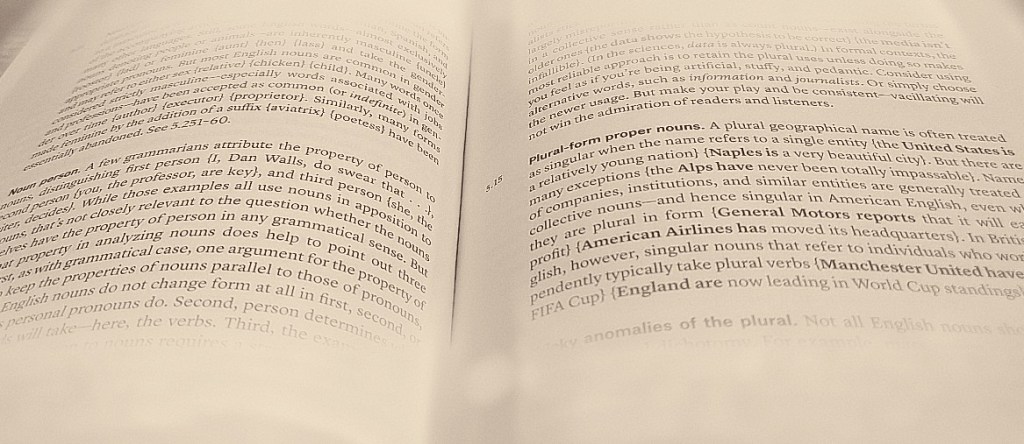
This week in my MFA publishing course we’ve been studying words — not writing words, but words specific to the world of publishing. As someone who studied linguistics, I’m torn between how to describe this new vocabulary. Is it jargon? Is it a lexicon? Is it terminology? My best assessment is that it is a little bit of all of these. In reading over lists of words, many of which would be familiar in non-publishing contexts, we were to write about and reflect upon unknown words or phrases and how these may impact or have a place on our writer’s path. Because I often think in poetic frame, my first thought was to create a haiku with these words and phrases.

Black swan, long tail, DAD

Backlist, ONIX, remainder

Colophon, frontpiece.

Against-the-grain, bulk

Earn-out, card deck, leasing, floor

Single-title-author plan.

Preprint, mobi, slush

Back matter, EAN, PPB

Midlist, sweet spot, yeah!

In putting this haiku together, I did aim for the word that I’m most drawn to as I think it is perhaps what I am aiming for: midlist. From the American Association of Publisher’s list of commonly used terms, midlist refers to, “Books with a strong intellectual or artistic bent which have a chance of significant success but are not assumed likely bestsellers.” The last line of my haiku illustrates how I feel about this term: sweet spot. Yes, it would be lovely, gratifying and all those similar feeling words to have a best seller. But in reality, I’m not even aiming for that in undertaking an MFA and this year-long study of publishing. My sweet spot is intellectual writing, with an artful leaning. Whatever I’m writing I know has a pretty good chance of being successful as I define it (a constantly evolving evaluation). Aiming for midlist feels attainable. Accomplishable; in a publisher’s catalog, perhaps in the poetry or monograph section, maybe memoir and maybe in that special section of mash-ups that cross all of those areas. Browsing Politics and Prose’s shelves last weekend showed there are plenty of books that fall into this mushy area: some art, some prose, not on the front shelves, but not in the clearance section either. Solidly midlist.

Learning the publishing side of words can feel a bit daunting — from the language to the layers of the business; it’s hard to imagine at this stage ever being fully versed in this language when I’m already fluent in two other vocabularies of business (higher education teaching and nonprofit management). On this too, after a week of pouring over lists of words, I think “midlist” is the spot to aim here as well: aim for high middle, narrow down the focus, work to apply other vocabularies to the learning to create yet another mash-up.

Accomplished #bostonmfa #morningview (a few weeks ago)

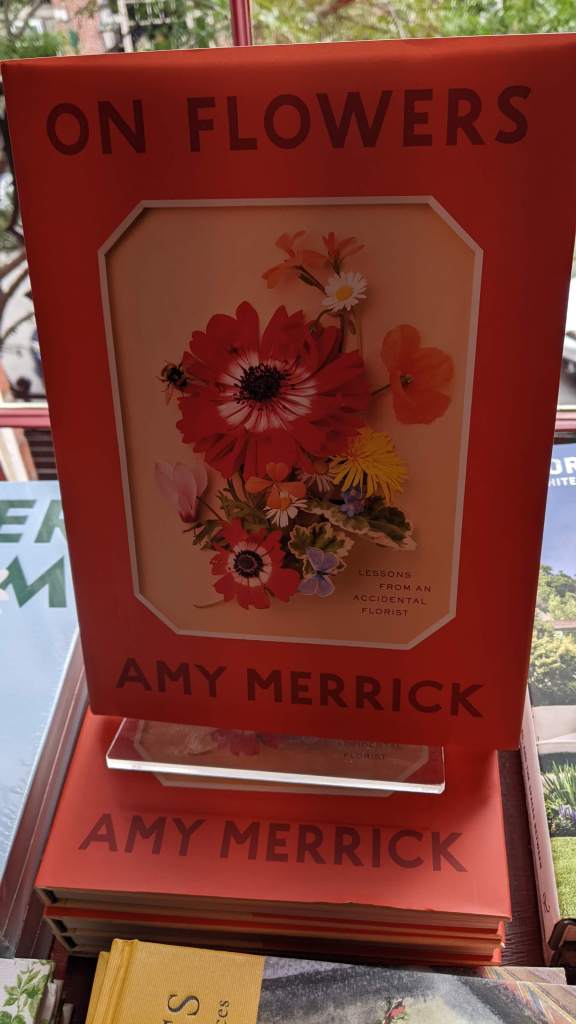
On Flowers by Amy Merrick is a book I spotted recently at Boston’s Museum of Fine Arts — I didn’t want to carry the hardback home on the train so it’s on my wishlist for two reasons: it is beautiful and it is a great model for the type of writing I want to do.

I’m in my second year of an MFA program, which some in my world already know (but many do not). I considered heading down this road for years and here I am, right in the middle of the process. A current class I’m taking has me finally focusing on my blog, and investigating my thoughts about what being a writer means to me. Today, this road takes me to what it means to be accomplished, where this program has taken me so far (and where I hope it will go) and the differences and overlap between successful and accomplished.

What does being accomplished mean to me? I felt that before I addressed this question, I needed to know more about the word and its roots as in usage, accomplished is heaped with emotion and I wanted to remove that element to begin my thoughts. From the Oxford English Dictionary, the etymology of accomplish dates back to the 13th century Italian, Spanish, Catalan and Old Occitan (had to look this one up = historical Romance language leading to lyric poetry). Two definitions from the OED standout to me: To fulfil, perform, or carry out successfully (an undertaking, desire, request, etc.); to achieve (one’s object) and to make complete or perfect; to fit out or equip. This definition I found to be worth more consideration, though the OED states it is no longer common usage: To complete, spend, or pass (a period of time); to reach (a certain age). Accomplished to me is a combination of all of these definitions: a completed body of work, a completed course of desired action, achievements of my own definition and to spend periods of time working toward my desired body of work. I try, to varying degrees, to hold to these ideas as I know what I have accomplished to date, and will in the future, as these values are intrinsic — what I consider accomplished may not meet the definition of external forces (though acceptance and accolades are two things I certainly want).

In what ways have you become more accomplished during the course of this program? Now that I’m in my second year, I find the rearview on year one to be one that I absolutely treasure for the change it brought to my life in so many ways: from my ability to start and maintain my countenance and momentum through incredibly trying times to finding my lost writing voice. This is not to say that at times (many) I wondered how I could ever balance this commitment; but I did move through each step because it quickly became apparent that this program is about me and work that I produce is for myself (and readers one day), not work in service to others. These may sound like intangible accomplishments, but to me these are rock solid as I move into a new phase of my life. On the more tangible side, consistency in writing is a major accomplishment, that has led to production — this is one aspect I had hoped to gain by going into this program.

Is there a connection between being an accomplished writer and a published writer? Tricky question. I’ve known many accomplished writers over my life and their work might be buried in government reports, association magazines or bundles of letters — but these writers are not published in the way we might usually think of it. We all want to be published writers, and I think there are many routes to publication — I would love a best seller just like every writer, and I hate rejection emails just like every writer — but I know I’ll feel the most joy if I’m producing work that I feel good about and it finds its way to the right publication for the work. One great aspect of this course in publishing so far is expanding my own thoughts on avenues — some of which I already knew about but hadn’t put the “publishing lens” to before. Yes, I would love to publish my thesis in book form and have it reach readers that find it meaningful.

Is there a difference between being successful and accomplished as a writer? Yes. Success also has many layers to it and definitions society ascribes to it that make it something of a minefield to me. There are bestsellers that I will never understand and cannot get through; and plenty of essays that feel like gibberish from successful writers. There are many accomplished writers that put in all the elements that could lead to a bestseller, but never attain that ranking — so in many ways success can be artificial. I think this one really depends on how we define success for ourselves. I used to think I would love to give up my day job (currently teaching English to college students) and write as my main activity/income generator — but now I’m not so sure; yes, I would like to write and also earn from that, but I also know I need different inputs and I have a lifetime of skills that I want to and should use as well. Moving toward a more writing-friendly day job is certainly in the forefront of my mind as I write this post (teaching composition doesn’t mean the composition professor has a ton of brain cells left over for her own creative work each day). To wrap-up: yes, there can be, should be, and are differences between successful and accomplished but these don’t necessarily need to be in separate silos — there should be cross-over on this winding path.