
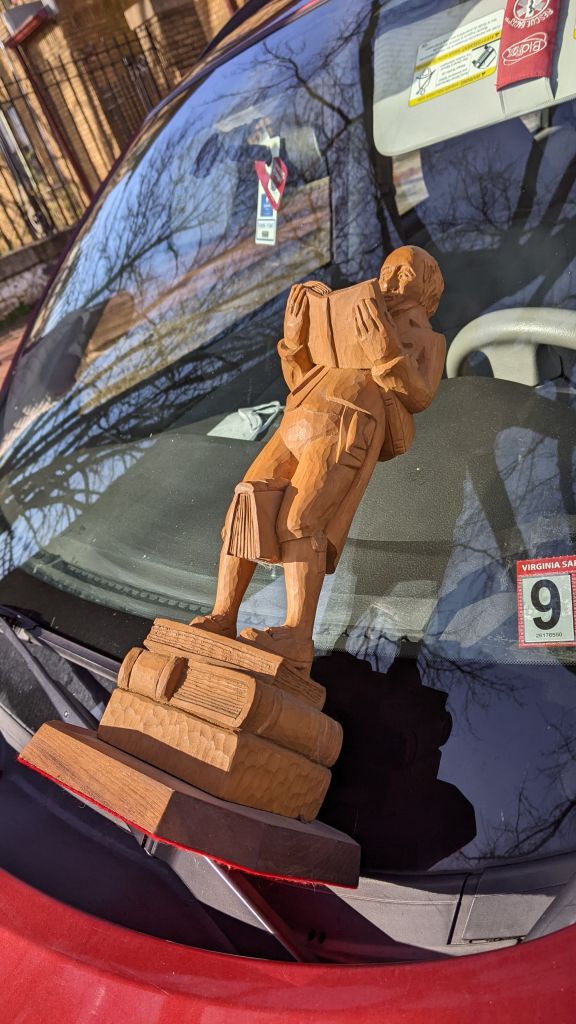
Ben Franklin on my Windshield

Yes, that’s a mini wooden statute of Ben Franklin reading a book, left mysteriously on my car’s windshield recently while my daughter and I were taking a stroll through Congressional Cemetery. Cemetery walking in DC is a THING, it’s normal and at Congressional it’s the best dog meetup in town, as the cemetery offers a membership for dog walkers. To us, it’s dog therapy, as the many fluff balls there on doggy recess will often approach, looking for a little extra love. We come here to gaze at the cherry trees that grace the well-worn rows of graves as well, far away from the hordes that descend on the tidal basin; and of course, for the history — if you really want to know this town, Congressional is one of the must- see, do learn places.

On this day though as we jumped back into “Red” as our Subaru is called, for her cherry-ish coloring, as I was about to put the key in the ignition, I naturally glanced out the front window and well, with me and my language, “What the hell” came out. We both hopped out of the car, and for nearly a minute just gazed at this little statue, resting so peacefully on the glass on this early spring day. Now, Congressional is not located on the best part of Capital Hill — it is a greatly improved area, but its patrons and permanent residents rest in the shadow of the D.C. jail — home to the notorious and temporary law breakers in the city. The neighborhood, glammed up rowhouses aside, does draw the notorious and temporary’s associates to the area, who do have “leave-behinds” that unflatteringly grace the sidewalks on occasion.

My first reaction to the statue: Do we still have any medical gloves in the car from early Pandemic gas getting? No, but we do have an old pair of winter gloves. But where to put Ben? Leave him on the cemetery stoop? Who would leave such a thing? Is it because of all the bookstore stickers on the car? Who is just walking down the road with a Ben to leave on someone’s car? Ben did find a resting place, thanks to a Congressional staffer (cemetery, not Hill) headed inside that offered to place him in the sun, near the office’s entry, but not before she too, asked: Why, who, huh?

This may seem like a long wind-up to sum-up this semester’s adventures in the world of publishing, but while reflection starts with a look-back, it most often leads to more questions. I have no idea who, what, why Ben was left on my car — but it sure is a great story. After a wonderful semester of interning (which still feels really odd at my age, can we think of a new term for this?) with an amazing organization, I can say here in late April, what I have is questions. I’ve written my writer’s contract with many specifics (and notes to add off-ramps and rewards from K.W. – thank you), and several clear directions. But I’ll admit, last night when reading of bell hooks’ work and the volume of volumes she created, I had that oh-so-familiar feeling that I’m spinning my wheels. It was also a long day of grading essays, which often leads to a certain amount of despair, but today I plan to greet the day anew…no more comparing my lack of volumes to anyone. The journey is just the journey, and some days aren’t going to be great when it comes to production, focus, or walking on the treadmill of life (hence off-ramps and rewards, thanks x two, K.W.).

My internship will continue into the summer (yeah), and I will be able to work again with my organization’s team as well as one of my treasured MFA mentors, write in the realm of spirituality, and perhaps board yet another train north to Philadelphia. Ben Franklin. Philadelphia. Ben Franklin. One book on my to-read list is Signs: The Secret Language of the Universe. As a person who thinks every blue bird is my grandmother visiting with a message, I am pretty convinced Ben’s appearance on my window is no coincidence. Philadelphia. Ben Franklin. Philadelphia. Ben Franklin. Books, books, books. Write, write, write — hello thesis year! Shall I dedicate it to Ben? One more question to ask, and answer.
Where are the writers in publishing? Look to the foundations.

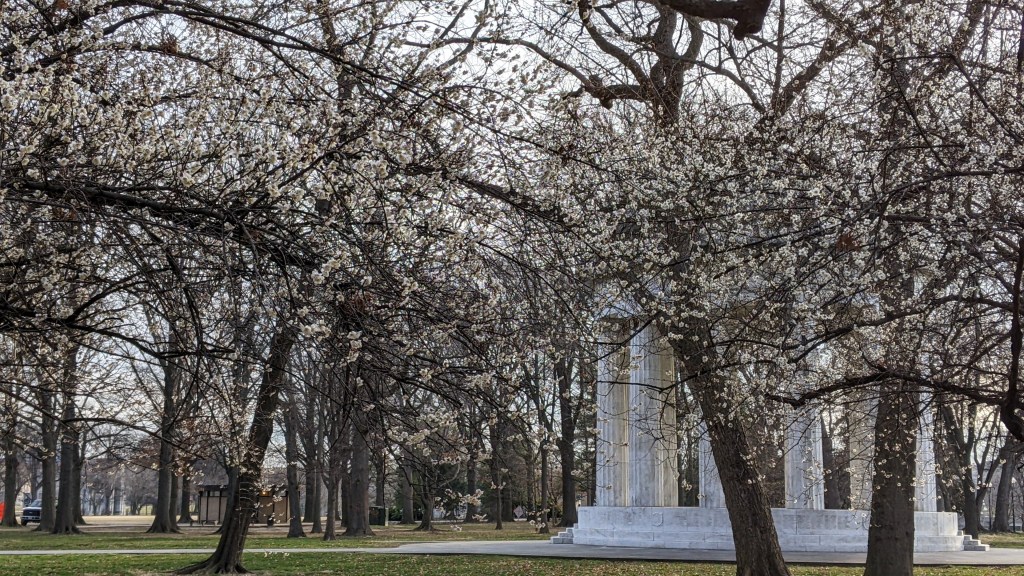
Recently on one of my morning walks, I snapped this photo of early cherry blossoms near the WWI Memorial just off the Washington Mall. On the base on this marble memorial, that changes hue as the sun rises and sets, are the names of D.C. residents that lost their lives in the Great War. Often when I’m walking near by in the early morning, photography equipment graces the steps as soon-to-be brides and grooms or recent graduates in their flowing robes gaze dreamily into the distance –maybe thinking of the past, maybe thinking of the future — but I’m guessing not thinking of the names or memories upon which they stand. In this photo, I particularly enjoy how the memorial is graced with these new blossoms, but also partially hidden – but solid, and foundational as well to the blossoms’ new found existence and beauty.

So too, are writers in publishing. Writers are everywhere — they are the foundation upon which publishing rests and they are everyone that works within, near, adjacent to, and down the road from publishing. In my view, we often think of the real writers as the stars whose names grace book covers or magazine tables of contents; but writers are involved at every step of the way from the website copy of any journal to tweets to contract drafting. These behind-the-scenes writers that often don’t have bylines or signatures are no less creative that those whose books and articles we readers soak up with glee upon publication; these writers make writing happen — they are the foundation, the marble, often hidden, but right there in lockstep with the cherry blossoms. These writers often have not-so-apparent creative writing lives as well, that they work on in the after-hours, crafting away when our own ideas have gone to press (or web, or the myriad of other forms writing gets out into the world).

In my own publishing internship, writers are all around me as every staff person writes in a variety of capacities nearly each day whether for the organization’s blog, editing work of guest writers, composing reports or marketing materials or grant drafts– words are all around everyone, everyday. For me, I’ve had the chance to complete two byline pieces so far (publication pending in April) and will be beginning my next piece within the next several weeks. Writing is the foundation here, whether in front of the camera so to speak appearing in the magazine, or in all that makes the magazine happen (and there is much).

I’ve spent the last few days with friends, one of whom is a writer for a national architecture firm — he’s written books, more articles than I could count if I tried, served as an editor for an architecture magazine, and he’s done a little freelance work for the local PBS station as well. What ties his work all together is the idea that writing is everywhere — there is always a story to tell, though every story is not glamorous perhaps, it is worthy of telling because there are readers out there that need and want to know things about his firm’s projects, or architects or their clients. These reaffirm my own ideas that have taken shape this semester, combined with my own past experiences: writers are all around, within every corner of publishing, and there are a vast number of ways to be a writer.

The Vocabulary of Publishing #morningview #mfa

This week in my MFA publishing course we’ve been studying words — not writing words, but words specific to the world of publishing. As someone who studied linguistics, I’m torn between how to describe this new vocabulary. Is it jargon? Is it a lexicon? Is it terminology? My best assessment is that it is a little bit of all of these. In reading over lists of words, many of which would be familiar in non-publishing contexts, we were to write about and reflect upon unknown words or phrases and how these may impact or have a place on our writer’s path. Because I often think in poetic frame, my first thought was to create a haiku with these words and phrases.

Black swan, long tail, DAD

Backlist, ONIX, remainder

Colophon, frontpiece.

Against-the-grain, bulk

Earn-out, card deck, leasing, floor

Single-title-author plan.

Preprint, mobi, slush

Back matter, EAN, PPB

Midlist, sweet spot, yeah!

In putting this haiku together, I did aim for the word that I’m most drawn to as I think it is perhaps what I am aiming for: midlist. From the American Association of Publisher’s list of commonly used terms, midlist refers to, “Books with a strong intellectual or artistic bent which have a chance of significant success but are not assumed likely bestsellers.” The last line of my haiku illustrates how I feel about this term: sweet spot. Yes, it would be lovely, gratifying and all those similar feeling words to have a best seller. But in reality, I’m not even aiming for that in undertaking an MFA and this year-long study of publishing. My sweet spot is intellectual writing, with an artful leaning. Whatever I’m writing I know has a pretty good chance of being successful as I define it (a constantly evolving evaluation). Aiming for midlist feels attainable. Accomplishable; in a publisher’s catalog, perhaps in the poetry or monograph section, maybe memoir and maybe in that special section of mash-ups that cross all of those areas. Browsing Politics and Prose’s shelves last weekend showed there are plenty of books that fall into this mushy area: some art, some prose, not on the front shelves, but not in the clearance section either. Solidly midlist.

Learning the publishing side of words can feel a bit daunting — from the language to the layers of the business; it’s hard to imagine at this stage ever being fully versed in this language when I’m already fluent in two other vocabularies of business (higher education teaching and nonprofit management). On this too, after a week of pouring over lists of words, I think “midlist” is the spot to aim here as well: aim for high middle, narrow down the focus, work to apply other vocabularies to the learning to create yet another mash-up.